

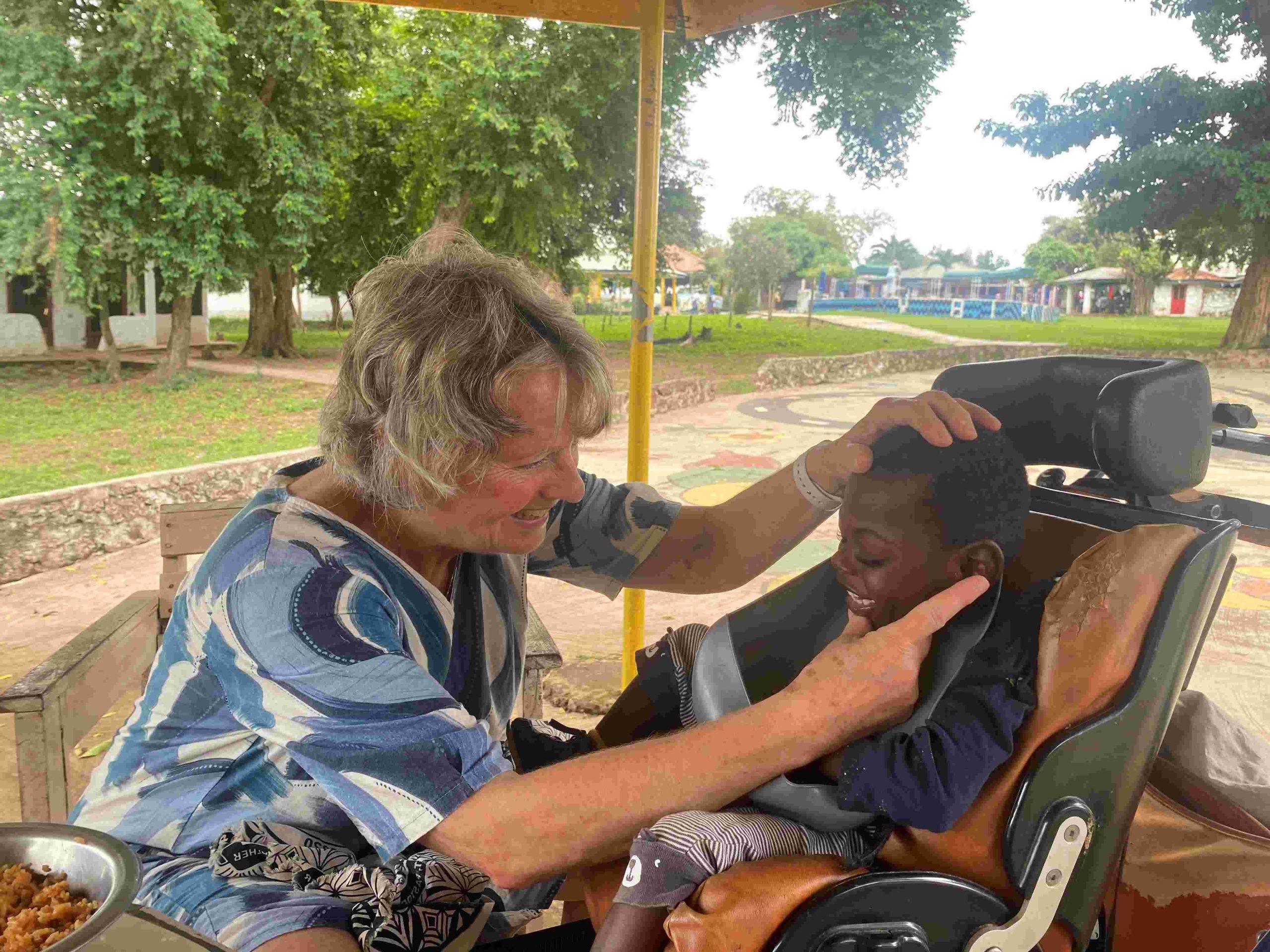
This time, a column by Dineke Blom (66), who recently spent two weeks working as a speech therapist at PCC.
Dineke:
My first introduction to PCC was in 2020, being a guest at PCC for two days during a trip through Ghana; it was a special experience.
Before my retirement (2022), I worked as a speech therapist with children with brain damage and adults with acquired brain injury.
Never before had a speech therapist been active at PCC. This spring, I received a request to dedicate myself at PCC to train the caregivers in safe eating and drinking and in communication.
I was welcomed by Joe Emma, various children, and volunteer Charlotte. She accompanied me for two weeks and, after my departure, continued what I had started, and she is doing a wonderful job.
On day 1, a girl from outside PCC came for adjustments to her wheelchair and other facilities. She cannot speak, but wants to make everything clear. She does this mainly with a few gestures. We were able to create a simple communication card with symbols for her. Now she can point to what she wants to make clear, for example: “drink, go to the toilet, Mommy’s phone,” etc.
Safe eating and drinking
The first week focused primarily on safe eating and drinking.
I started working with Markus and William; they have a lot of trouble getting food down and choke regularly. There are concerns about their weight.
We ensured a better feeding situation: more calm, a different posture for both child and caregiver, a different spoon and cup, and food that is easy to swallow.
In addition, all caregivers were trained. They received an explanation regarding the normal development of eating and drinking and the problems children with brain damage face. They learned the correct way to offer food and drink, use proper spoons and cups, what to do in case of choking, etc.
The caregivers experienced firsthand what it is like to be fed with your head tilted back (which I often saw happening). This led to a lot of hilarity… and at the same time, it was very enlightening: that is not nice at all, you can easily choke like that!
It was wonderful to see that the caregivers tried to apply all the advices. Questions came up regularly, or requests for a different cup or spoon. Of course, it takes time to change habits.
Communication
During the second week, I focused on communication, especially with a few children who (try to) communicate using gestures, such as Patience and Sadat.
Sadat understands quite a lot and wants to make himself clearer than he is capable of. Speaking is barely possible due to his spasticity.
That is why we made a communication card for him, with symbols chosen by him, for example, “call” (= via Joe Emma to his brother) and “stop”, when other children tease him.
Sadat is very motivated and enthusiastic and learns quickly.
The next step was explaining to his caregivers how to communicate using that card. Sadat was very clear: he wants to do that himself (with our help)!
Naturally, when you are 26, you want to manage your own affairs.
Sadat also had a symbol for “thank you” on his card, something he had never been able to express clearly before. When I concluded the last session with Sadat, he gestured “thank you” with a happy smile.
It moved me, he was genuinely happy with everything he had learned. How remarkable it is that he is always happy and cheerful, despite his significant limitations!
Patience cannot speak due to brain damage and communicates via a few gestures, but she has more to offer. An iPad was her favorite; she searches for games or photos of children herself and then pointed those children out to me.
A communication card is not yet usable for Patience, perhaps later…?
Two images are now being added to her wheelchair tray to clearly indicate “Yes” and “No.”
Abel is a new resident whom we believe can learn to speak. All the prerequisites are met: he makes eye contact, looks to you in the eye, and can imitate gestures. Perhaps he only needs a small “nudge” to get speaking started.
I also gave training sessions on communication.
How does normal development proceed? How is that for children at PCC?
What is non-verbal communication: gestures, body language, and facial expressions.
The caregivers were allowed to pass simple messages to each other without speaking:
“I am tired, I am hungry / thirsty, I want to go to the toilet,” etc. This also caused a lot of hilarity.
An important message was: look closely at a child who cannot speak! Is he making gestures, pointing, or looking at something? Name what you see and check if that is correct.
Jeannette and Albert arrived during the last weekend of my visit to PCC. It was wonderful to meet these two special people, who have meant so much to PCC for so many years.
Upon leaving, I felt that I was far from “finished”; there is still so much to do. Fortunately, Charlotte and I are still in regular contact regarding children like Sadat, Patience, and Abel, as well as on the follow-up on the advice given.
This way, I still feel like I am somewhat present and able to support PCC.
And who knows, maybe I will come back someday.
Working at PCC is totally different from what I was used to. In Ghana, it is back to basics: no complicated technology, but simple tools. A card or a personal communication booklet can already greatly expand communication possibilities.
PCC has stolen my heart. I look back on a wonderful time and am deeply impressed by the loving and warm environment that PCC offers to the residents, as well as by the beautiful surroundings, the scents, and the chickens, goats, and 2 donkeys roaming around.
From now on, the sound of a crowing rooster will always bring me back to PCC for a moment.